
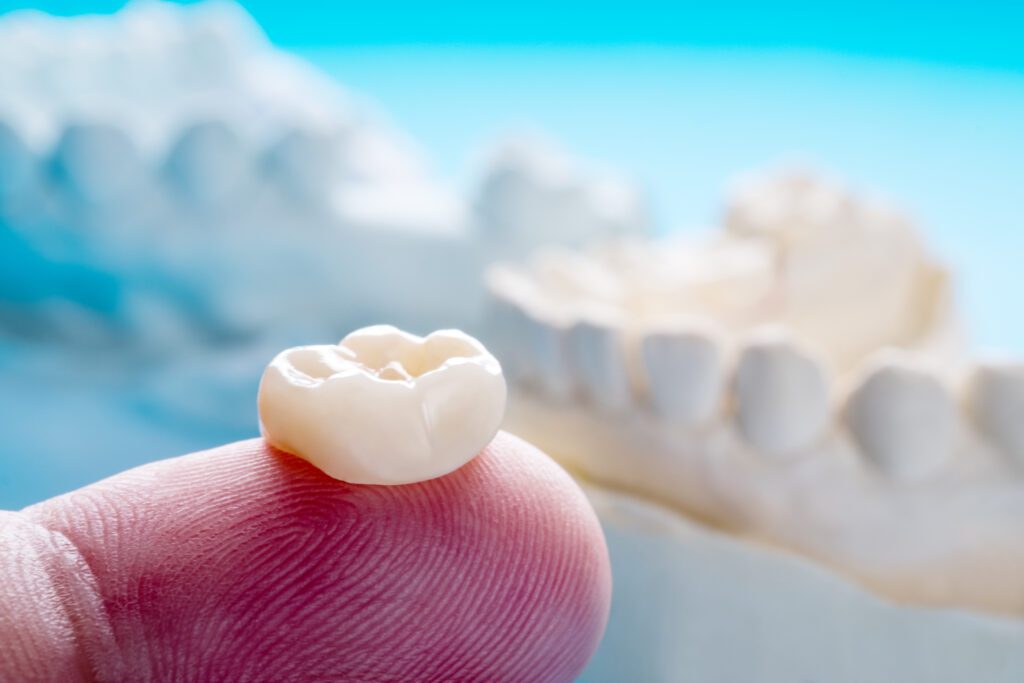
If you’ve ever left a dental appointment with a treatment plan that included words like “crown” or “filling” and wondered what the real difference is, you’re not alone. Patients at Jackson Family Dentistry in Downers Grove often ask this question, and it’s a good one. Both crowns and fillings repair damaged teeth, but they’re used in different situations and involve different levels of tooth restoration. Understanding when each is recommended can help you feel more confident about your treatment plan.
What Is a Filling, Exactly?
A filling is the more familiar of the two treatments. When a tooth has a small to moderate cavity, your dentist removes the decayed portion and fills the resulting space with a durable material, typically a tooth-colored composite resin. Fillings are quick, minimally invasive, and preserve as much of your natural tooth structure as possible. They’re ideal for cavities caught early, before decay has spread deep into the tooth.
When Does a Tooth Need a Dental Crown Instead?
A dental crown comes into play when a tooth’s damage is too extensive for a filling to handle. Think of a dental crown as a custom-made cap that covers the entire visible portion of a tooth above the gumline. Unlike a filling, which only fills in a small area, a dental crown surrounds and protects the whole tooth structure. Eric G. Jackson, DDS, typically recommends a dental crown when a tooth has a large cavity, a significant crack, has undergone a root canal, or is too weak to support a filling on its own.
How Do You Know Which One You Need?
The decision between a filling and a dental crown usually comes down to how much healthy tooth structure remains. If there’s enough intact tooth to support a filling without risking further breakage, a filling is the more conservative option. But if a large portion of the tooth is compromised, a dental crown provides the strength and stability needed to prevent the tooth from cracking or failing altogether. During your exam, Dr. Jackson will evaluate the extent of the damage using digital X-rays and a visual exam to determine the most appropriate, least invasive option for your situation.
What Does the Process Look Like for Each?
Getting a filling is usually a single, straightforward visit. The decayed area is removed, the tooth is cleaned, and the filling material is placed and shaped to match your bite.
A dental crown involves a bit more planning. First, the damaged or decayed portion of the tooth is removed and the remaining structure is shaped to accept the crown. At Jackson Family Dentistry, we use a digital iTero scanner to capture a precise digital image of your tooth, so there’s no need for the messy impression trays or putty many patients remember from past visits. That digital scan is used to design a dental crown that fits your bite accurately and comfortably. While your permanent crown is being made, you’ll wear a temporary crown. It is doing more than filling the gap. It protects the prepared tooth, keeps the neighboring teeth from drifting into the space, and keeps the bite where it should be, so if it ever comes loose, call us rather than waiting for the next appointment.
What Does a Crown Cost the Tooth?
A crown is the more protective option, and it asks more of the tooth to provide that protection. Preparing a tooth for a full crown means reducing it on every surface, and depending on the tooth and the material, that can mean shaping away up to about two-thirds of the visible tooth. That structure does not grow back, which is why the decision is worth making carefully rather than by default.
There is a second consequence worth knowing before you agree to one. Because the preparation brings the drill closer to the nerve, some crowned teeth later need a root canal. The figures vary, but somewhere up to around one tooth in seven over ten years is a fair estimate, and the risk is higher in teeth that already carry deep or multiple fillings. Most of it shows up in the first few years rather than gradually over a lifetime.
That is not a reason to avoid a crown when a tooth genuinely needs one. It is a reason not to place one when something less would do the job. And it is worth saying that doing a root canal ahead of time, just in case, is not the answer either. There is no evidence supporting that, and it removes more structure from a tooth that may never have needed it.
There’s a Middle Option Too
The choice is not only between a filling and a full crown. An inlay or onlay, sometimes called a partial crown, is made in a laboratory like a crown but replaces only the damaged part of the tooth, covering a weakened cusp where one needs covering and leaving the rest alone.
The research on these is encouraging. Survival at five years runs above 90% for both onlays and full crowns, with no meaningful difference between them, while an onlay removes somewhere between 20% and 45% less tooth structure. For a large but otherwise healthy back tooth, or a tooth being restored after a root canal, an onlay often does the same job with less taken away.
A full crown is still the right answer when very little sound tooth remains, or when the whole tooth needs to be encircled to hold it together. A cracked tooth with symptoms usually needs full cusp coverage, and that is not a place to be conservative.
Which Option Lasts Longer?
Crowned teeth do last longer on average, but the gap is smaller than most people expect. A large study following more than 340,000 restored teeth found about 93% of crowned teeth still in service at ten years, compared with about 89% of teeth restored with large multi-surface fillings. That’s a real difference, but it isn’t the difference between permanent and temporary.
Two things are worth knowing alongside that number. A crown is not forever either, with roughly one in five needing attention within ten years and about one in three within fifteen. And a well-placed large filling is a legitimate long-term restoration in its own right, commonly lasting ten to fifteen years, not a stopgap waiting to be replaced.
The crown becomes the clearly better answer when a lot of tooth structure is already gone, or when a cusp is cracked and needs to be held together. For a moderate cavity in an otherwise solid tooth, a filling is often the better choice, and choosing it is not settling for less.
Will a Filling Be Replaced With a Dental Crown Later?
Sometimes, yes. Teeth with large or aging fillings can eventually crack or weaken to the point where a filling is no longer enough to hold them together. In these cases, a dental crown may be recommended to protect the tooth from further damage and avoid the need for extraction. This is one reason routine checkups matter. Catching problems early often means simpler, less costly treatment.
Trust Your Downers Grove Dentist to Guide You
Whether your tooth needs a simple filling or a full dental crown, the goal at Jackson Family Dentistry is always the same: preserving as much of your natural tooth as possible while restoring its strength and function. Dr. Jackson takes the time to walk patients through their options and explain exactly why a particular treatment is recommended, so you never feel left in the dark about your care.
Ready to Get Your Tooth Evaluated?
If you’re dealing with tooth pain, sensitivity, or a cracked tooth and aren’t sure whether you need a filling or a dental crown, don’t wait for the problem to get worse. Contact Jackson Family Dentistry at (630) 963-6750 to schedule an evaluation. Our Downers Grove team is here to help you find the right solution for a healthy, comfortable smile.