
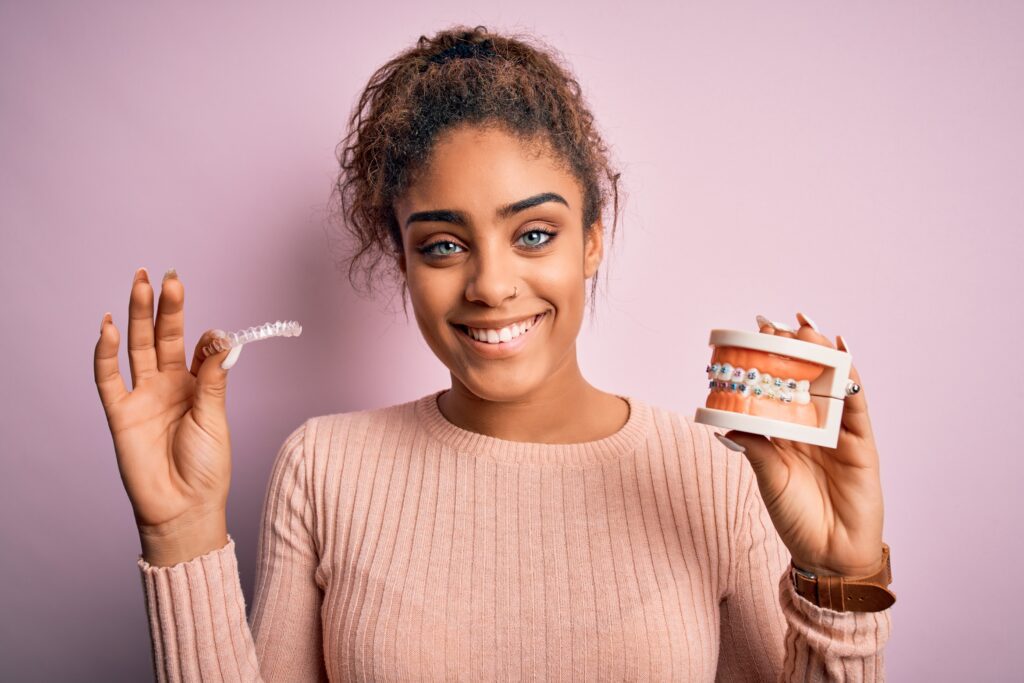
Life With Invisalign Vs. Braces
Thinking about orthodontic treatment but not sure which option fits your lifestyle? Here’s what to expect day to day with each.
If you’re weighing your options for a straighter smile, the question of Invisalign vs. braces probably comes up pretty quickly. Both treatments are effective, but the day-to-day experience of wearing them is quite different. At Jackson Family Dentistry in Downers Grove, Dr. Eric Jackson helps patients understand exactly what they’re signing up for so they can make a confident, informed choice. Here’s an honest look at how life changes depending on which path you choose.
What Do You Actually Wear Each Day?
With traditional braces, you’re wearing a fixed system of metal brackets and wires bonded directly to your teeth. You don’t take them out. They’re there when you wake up, when you eat, when you sleep, and when you’re at work or school. For many patients, this means a brief adjustment period as the mouth adapts to the hardware.
Invisalign, on the other hand, uses a series of clear, custom-fitted plastic aligners that you remove throughout the day. You wear them for 20 to 22 hours daily, which means you’re taking them in and out multiple times whenever you eat, drink anything other than water, or brush your teeth. The visibility difference is significant too. Traditional braces are noticeable, while Invisalign aligners are nearly invisible to most people.
How Does Eating Change?
This is one of the biggest practical differences in the Invisalign vs. braces conversation. With braces, certain foods become off-limits or risky. Popcorn, hard candies, apples, corn on the cob, chewy breads, and sticky sweets can all damage brackets or get stuck in the wires. Patients with braces often find themselves cutting food differently or avoiding certain favorites altogether for the duration of treatment.
With Invisalign, you remove the aligners before eating, which means there are essentially no dietary restrictions. You can eat whatever you want. The tradeoff is that every meal requires you to brush your teeth before putting the aligners back in, which takes more discipline and planning, especially when you’re away from home.
What Does Oral Hygiene Look Like?
Brushing and flossing with braces takes considerably more time and attention. Wires and brackets create extra spaces where food and plaque can hide, and flossing requires threading through the wire at each tooth. Patients who don’t keep up with hygiene during braces treatment are at greater risk for staining, cavities, and gum irritation.
With Invisalign, oral hygiene is much closer to your normal routine. You remove the aligners, brush and floss as usual, clean the trays themselves, and put them back in. That said, the requirement to brush after every meal is a real commitment. Skipping this step and putting aligners back in over food residue creates an environment where bacteria can thrive.
Is One More Comfortable Than the Other?
Both treatments involve some degree of discomfort, particularly in the early days and after adjustments or aligner changes. Braces can cause soreness and irritation from brackets rubbing against the inside of the cheeks and lips. Patients often rely on orthodontic wax to cushion sharp spots.
Invisalign aligners are smooth and generally considered more comfortable, but they can still cause pressure and soreness, especially with each new set. Neither option is painless, but the type of discomfort differs. Most patients adapt to both over time.
How Do They Fit Into Social and Professional Life?
For teens and adults who are self-conscious about their appearance, this is often the deciding factor in the Invisalign vs. braces debate. Invisalign’s near-invisibility makes it a popular choice for working professionals, college students, and anyone who speaks publicly or appears on camera regularly.
Braces are more visible, which some younger patients don’t mind at all, especially since colored bands have become a fun way to personalize the look. For others, the aesthetic factor weighs heavily. There’s no right or wrong answer here. It comes down to personal preference and lifestyle.
Which Option Requires More Discipline?
Braces require essentially no willpower to wear since they can’t be removed. Invisalign requires consistent self-discipline to keep them in for the required hours each day. Patients who remove them too frequently or forget to put them back in after meals may see slower or less predictable results.
Dr. Jackson at Jackson Family Dentistry takes time to discuss these factors honestly with every patient before recommending a treatment path.
Ready to Explore Your Options?
The Invisalign vs. braces decision is personal, and the best choice depends on your goals, lifestyle, and dental needs. Schedule a consultation with Dr. Eric Jackson at Jackson Family Dentistry in Downers Grove to find out which treatment is right for you. Call our office or request an appointment online to get started.